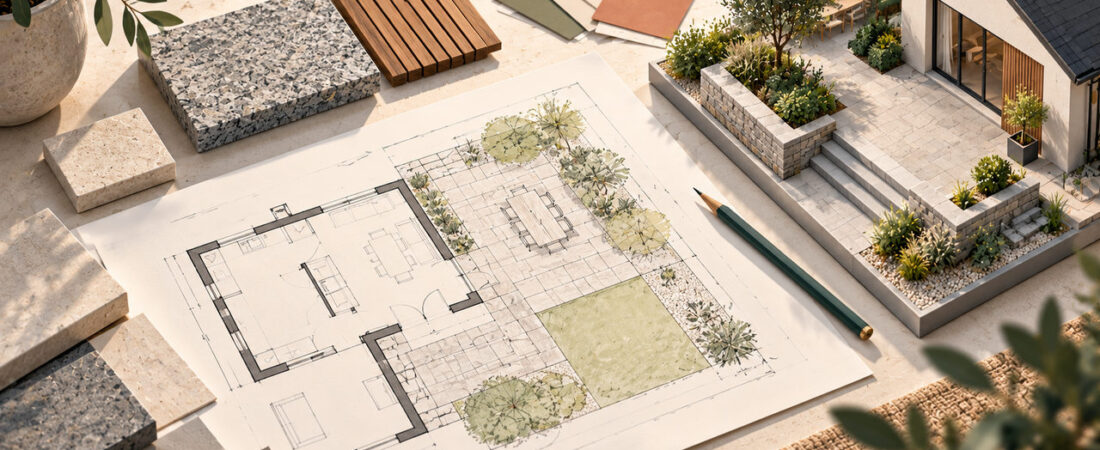
A collection of attractive photographs is a fine way to start a home project. It is a poor way to explain precisely what you want someone to build.
You can save twenty examples of beautiful kitchens, pin a dozen garden transformations and tell a builder you are after something ‘clean, timeless and low maintenance’. What have you actually communicated? A mood, certainly. Perhaps a rough direction. But almost nothing about the decisions that determine the cost, scope or success of the work.
This is partly a design problem, but it is also a writing problem. People often underestimate how much clarity matters when a project moves from an idea in one person’s head to drawings, estimates, orders and work on site. A phrase that feels obvious to you may leave a tradesperson with several reasonable interpretations.
A useful renovation brief does not have to be lengthy or full of technical vocabulary. It simply needs to state your priorities, distinguish requirements from preferences and make unanswered questions visible before they turn into expensive misunderstandings.
Start with the problem, not the photograph
Ask yourself what is wrong with the space as it works today. Perhaps the kitchen is attractive enough but you cannot comfortably cook while someone else passes through. Maybe the patio receives afternoon sun but becomes an awkward route between the house and a garden shed. Or a small extension is intended to create a quiet room, yet the real issue is noise travelling through the ground floor.
Write that problem down in plain language. ‘We need room for two adults to prepare food without blocking access to the back door’ is more useful than ‘we want a bigger, brighter kitchen’. It names the activity, the people involved and the obstacle. The designer still has freedom to find a solution.
The Royal Institute of the Architects of Ireland’s guidance for homeowners explicitly places brief development near the start of the process and recommends taking stock of what works and what does not in the existing home. That is sensible advice even if the project is too modest to need an architect.
Take a few ordinary photographs rather than only the most flattering ones. Show the narrow gap behind the door, the low point where rain gathers, the steps that make carrying shopping difficult. If the problem is intermittent, note when it happens. A sunny-day photograph will not explain a dark north-facing room in winter.
Once the problem is clear, the design inspiration becomes more useful. Images can show the atmosphere you favour without pretending to settle the technical questions.
Separate the non-negotiables from the nice-to-haves
One of the most expensive words in a project brief is ‘ideally’. It is not wrong, but it can hide the distinction between something you need and something you would merely enjoy.
Imagine writing: ‘Ideally, we would like wide doors, storage for bicycles, a seating area and easy access for an older relative.’ A contractor or designer might assume all four points deserve roughly equal weight. You may regard step-free access as essential and bicycle storage as optional. If that hierarchy stays in your head, nobody can reliably design to it.
Create three short categories: requirements, preferences and open questions. A requirement might be safe, practical access between the driveway and front door. A preference could be a particular colour of paving. An open question might be whether a change of level can be resolved within the space and budget available.
Be careful not to prescribe a technical solution you are unqualified to choose. ‘The route must be comfortable for a person using a walking aid’ is a meaningful requirement. ‘Use exactly this gradient and surface build-up’ is a specification that may need professional assessment.
Give the team a clear budget range and identify the items that must fit within it. Nobody benefits from a beautifully detailed proposal that could never have been affordable. Keep an allowance for unknowns, particularly when existing structures or buried services may be involved.
Replace attractive but slippery words with evidence
‘Premium’, ‘modern’, ‘characterful’, ‘practical’ and ‘easy to maintain’ are useful conversational shortcuts. They are not shared definitions.
Take ‘low maintenance’. For one homeowner it means a patio that can be swept and washed occasionally. For another it means no re-sealing, no specialist cleaning and no loose material to rake back into place. Both interpretations are reasonable, but they lead to different choices.
Explain what the phrase means in day-to-day life. How much time do you want to spend on upkeep? Will a wheelchair, buggy or wheeled bin travel across the surface? Are you willing to accept natural changes in colour, weathering or texture? Does the finish have to coordinate with existing stonework?
This becomes particularly important outdoors, where images conceal thicknesses, edges, falls, drainage and the characteristics of a material when wet. A sample that looks perfect indoors may be unsuitable for a particular route, exposure or use.
Instead of naming a favourite material and stopping there, record the properties the finished work needs. Suppliers’ catalogues can help you turn a vague visual preference into a more informed conversation. For example, the building and landscaping materials available from Midland Stone include paving, building stone and decorative aggregates, giving you a useful starting point for discussing appearance and application with a designer or installer. The final selection still has to be checked for suitability, correct detailing and maintenance requirements.
A good brief lets people understand what you value without locking them into a choice made after seeing one appealing photograph.
Write for two audiences: the designer and the builder
A designer needs to understand the life you want to lead in the space. A builder needs enough definition to price and deliver agreed work. Those audiences overlap, but they are not identical.
At an early stage, a sentence such as ‘we want the garden to be inviting for a small family gathering’ is useful. Later, someone needs to know the intended layout, finished levels, materials, edging, drainage strategy, lighting provision and how existing services will be protected. Not all of that belongs in a homeowner’s original note. Much of it should emerge through professional design and specification.
The mistake is treating the first conversation as though it already constitutes a final scope of works. A brief is the starting document, not a substitute for drawings, a detailed quotation, statutory checks or an appropriate building contract.
The Competition and Consumer Protection Commission advises homeowners to obtain written quotations and, before work begins, clear written details including the agreed price, the work being carried out, the payment structure and an estimated completion date. Its guidance on building-work disputes explains why a record of what was agreed matters if something later goes wrong.
That sounds unromantic, but there is freedom in making expectations explicit. You can enjoy the creative decisions instead of wondering which of them were included in the price.
Put the awkward questions in the document early
A brief should make uncertainty visible, not cover it with confident-looking language.
If an existing patio floods, say so. If you suspect the garden level is causing damp near an external wall, record the observation without diagnosing the cause. If the property has been altered before and you have no drawings, tell the professional team at the outset. A useful brief makes it easier to recognise what needs checking.
Pay particular attention to permissions, compliance and the relationship between new work and the existing house. The rules depend on the type of proposal and property. Do not copy a general internet statement that an extension or garden structure is ‘planning exempt’ into the project brief as though it settles the issue. Seek the appropriate planning and building-control advice for the actual works.
Energy improvements need similar coordination. New windows, heating systems, insulation and ventilation can interact, so it may be unwise to treat every measure as an isolated purchase. The Sustainable Energy Authority of Ireland’s home upgrade guidance sets out different approaches to planning upgrades and points homeowners towards current grant eligibility. Check approvals and scheme conditions before starting any grant-funded work rather than building an unverified assumption into your budget.
Questions are not signs of a weak brief. They show the project is being considered seriously. The danger lies in a question that nobody knows has been left unanswered.
Give each decision an owner and a deadline
A renovation involves a surprising number of small decisions. The main floor finish may be agreed, while nobody has decided on the threshold detail. The kitchen layout may be approved, but the location of a socket remains unresolved. A landscape design can be accepted in principle while the edging material is still described as ‘something similar’.
You do not need complicated project software to control this. Keep a simple decision log that states what needs deciding, who is responsible, when it must be resolved and which drawing, quotation or instruction records the answer.
Make changes in writing. If you ask for an adjustment during a site visit, follow it up with a short message describing what was discussed and asking for confirmation of cost and programme implications. Otherwise, an apparently casual suggestion can become the source of two competing recollections.
Ask for samples where appearance will influence the decision, and assess them in the location where they will be used. Note the exact product or approved alternative once chosen. ‘Something like the sample’ is not a particularly useful purchasing instruction.
This need not feel bureaucratic. The point is to reduce the number of decisions that must be made under pressure, when labour is booked and materials are already on the way.
Make the document easy to read, not impressive to look at
A good brief is written to be used. Give it a clear title and date, identify the property, describe the objectives, list requirements and constraints, and include photographs with short captions. Keep supporting inspiration separate from the essential decisions.
Avoid burying an important point inside a paragraph about atmosphere. If access, timing or a particular existing feature is essential, make it easy to spot. Do not send ten versions of a document with slightly different instructions and expect everyone to know which is current.
Plain language is an advantage. ‘Keep the side gate accessible throughout the works’ is better than an elaborate sentence about maintaining ongoing pedestrian permeability. Specialist terms belong where they add precision, not where they make ordinary requirements harder to understand.
Resist the temptation to solve every issue personally. You can describe the use of a space and the result you need, while leaving structural design, drainage calculations and statutory compliance to suitably qualified professionals. The brief should invite their expertise rather than compete with it.
When you send the document, ask recipients what is missing. A useful reply may expose a genuine ambiguity, a hidden cost or an assumption that would otherwise survive until installation.
The best brief leaves room for a better answer
You can be wonderfully specific about the problem and still stay open-minded about the solution. That is the real strength of a good brief.
Too much vagueness means people guess. Too much premature certainty means they cannot propose something better. The middle ground is to describe what you need, explain why it matters and make the practical constraints visible.
Before the first formal meeting, read the document as though you know nothing about the home. Can someone distinguish requirements from preferences? Do they understand the budget and the existing problems? Can they identify the questions that require professional advice? If the answer is yes, you have already improved the quality of the conversation.
Renovation projects will always involve compromises and discoveries. Clear writing cannot prevent every surprise. It can, however, prevent a great many arguments about what somebody thought somebody else meant.
And unlike a mood board, that clarity remains useful long after the last photograph has been pinned.